|
Main Advantages of
HDV
On September 30, 2003, the HDV
standard was agreed on by four companies: Canon Inc.,
Sharp
Corporation, Sony Corporation,
and the Victor Company of Japan,
Limited.
The concept of the HDV
standard is to develop a home camcorder, which can record easily
high
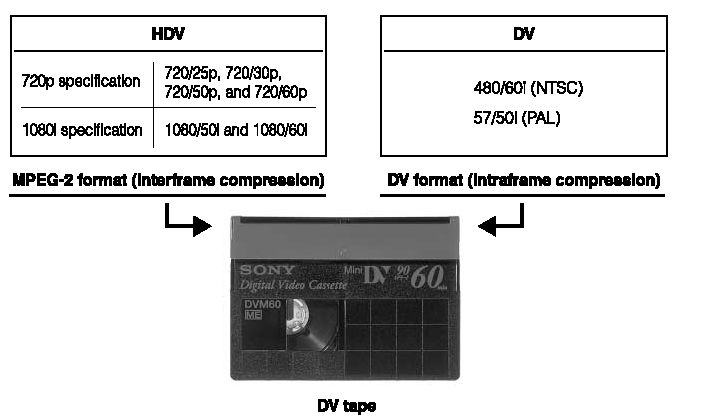
quality HD movies. The HDV
standard can be used with existing DV tape as the recording
media.
Thus, by using the mechanisms
of a DV camcorder, mitigation of development costs
and
development efficiency is
realized.
Feature No. 1: Recording HD images on DV
tapes
The same videotapes used for
DV recordings can also be used for HD recordings, and
the
recording time is also
equivalent. Furthermore, the main recording mechanisms are also the
same
as for the DV
standard.
Feature No. 2: MPEG-2 is used as the
compression format.
The same MPEG-2 compression
format that is used for digital broadcasts and DVDs is also
used
for HDV. Efficient compression
is possible while maintaining the high quality of HD
images.
Therefore, using the same bit
rate as for the DV standard, the recording and playing back of high
resolution
HD images has been realized.
In order to use MPEG-2 to compress the large quantity
of
HD image data, which is much
more than for the SD format, an extremely large signal
processing
circuit is required. However,
due to the advancement of semiconductors and signal
processing
technology, it is now possible
to use this format as a standard for personal
devices.
Feature No. 3: Powerful error correction
capability
With the MPEG-2 format, which
uses interframe compression, the impact of missing data is
much
greater than for the DV
standard where intraframe compression is used. For this reason,
the
amount of correction coding
has increased with the HDV standard. Moreover, by turning the
DV
correction method that only
operates within tracks into a correction method between multiple
tracks,
error correction capability
has been drastically improved, and the tolerance for data loss in
tracks
caused by dropouts is greatly
enhanced.
Feature No. 4: Same sound quality as a
CD
MPEG-1 Audio Layer II is used
for the audio compression format, allowing you to enjoy the
same
sound quality as from a
CD.
Feature No. 5: Two kinds of recording
systems
The HDV standard has two types
of recording systems: the 720p (progressive) specification
and
the 1080i (interlace)
specification.
|