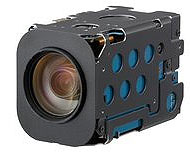
Sony FCB-EX1000P 36x PAL Color Block Camera
Product Code: FCBEX1000P


Features
• 1/4 type EXview HAD CCD
• Horizontal Resolution - 460 TV Lines
• Minimum Sensitivity of 1.4 lux (50 IRE)
• 432x optical zoom (36x zoom / 12x optical)
• High Performance Digital Signal Processor (DSP)
• Auto ICR (IR Cut filter Removal) Mode
• Electronic Shutter/Slow Shutter
• Alarm Function
• Picture Freeze Function
Sony's new FCB-EX1000P camera offers excellent picture quality and extremely high zoom capability. The Sony FCB-EX1000P color block camera combines a new exceptionally high 36X zoom
lens with an expansively wide/telephoto horizontal field of view. The FCB-EX1000P camera incorporates a ¼ type EXview HAD™ CCD for high sensitivity in extreme low light environments.
For optimized sensitivity in both day and night-time shooting applications, the FCB-EX1000 camera incorporates an Auto ICR function and excels in security domes and traffic monitoring
applications.
Highlights:
- 1/4 type EXview HAD CCD
- Horizontal Resolution - 460 TV Lines
- Minimum Sensitivity of 1.4 lux (50 IRE)
- 432x optical zoom (36x zoom / 12x
optical)
- High Performance Digital Signal Processor (DSP)
- Auto ICR (IR Cut filter Removal) Mode
- Electronic Shutter/Slow Shutter
- Alarm Function
- Picture Freeze
Function
- Electronic-Flip (E:Flip)
- High-speed serial communication (max. 38.4 kbps) and TTL signal-level control (VISCA™ protocol)
- Programmable factory preset
-
Various customizable settings
- Key switch control compatibility
- VBS and Y/C video output
- Spot AE
- Internal/External sync
|
| Camera Specifications |
| Image Device |
1/4 type EXview HAD CCD |
| Effective Pixels |
440,000 pixels |
| Digital Zoom |
12x (432x with optical zoom) |
| Horizontal Viewing Angle |
57.8° (wide end) to 1.7° (tele end) |
| Minimum Object Distance |
320 mm (wide) ~ 1500 mm (tele) |
| Sync System |
Internal / External (V-Lock) |
| Electronic Shutter |
1 to 1/10,000 s, total 22 steps |
| White Balance |
Auto, ATW, Indoor, Outdoor, One-push, Manual |
| Gain |
Auto/Manual (-3 to +28 dB, +2 dB steps) |
| EV Compensation |
-10.5 to 10.5 dB (1.5 dB steps) |
| Backlight Compensation |
On/Off |
| Privacy Zone Masking |
On / Off (24 positions) |
| Flicker Control |
Auto |
| Focus System |
Auto (Sensitivity: normal, low)
One-push AF
Infinity
Manual
Interval AF
Zoom trigger AF |
| Camera Operation / Zoom Switch |
Zoom Tele, Zoom Wide |
| Picture Effects |
E-Flip
Nega Art
Black & White
Mirror Image |
| Exposure Control |
Auto
Manual
Priority Mode
Bright
EV Compensation
Backlight Compensation
Slow AE |
| Video output Specifications |
| Lens Value |
36x |
| S/N Ratio |
More than 50 dB |
| Minimum Illumination |
1.4 lx |
| Video Output |
VBS: 1.0 Vp-p (sync negative)
Y/C |
| Signal System |
PAL |
| Horizontal Resolution |
460 TV Lines |
| Interface Specifications |
| Camera Control Interface |
VISCA (TTL signal level)
Baud rate: 9.6 Kb/s
19.2 Kb/s
38.4 Kb/s
1 or 2 Stop bit selectable |
| General Specifications |
| Dimensions (W x H x D) |
2 x 2 3/8 x 3 1/2 inches
(50.0 x 57.5 x 87.9 mm) |
| Weight |
8.1 oz (230 g) |
| Operating Temperature |
32 to 122 °F (0 to 50 C°) |
| Storage Temperature |
-4 to 140 °F (-20 to 60 C°) |
| Power Consumption |
1.6 W (motors inactive)
4.0 W (motors active) |
| Power Requirements |
6.0 V ~ 12.0 V DC |
|
|